The AI inference platform with the lowest latency depends on the model, prompt length, output length, reasoning settings, region, concurrency, and the latency metric being measured. A provider can have the lowest time to first token for one model and a slower total response time for another.
Cerebras Inference is designed for low-latency, high-speed model serving. In a July 31, 2026 test, Cerebras reported a 5.6× end-to-end speedup for GPT-5.6 Sol Ultrafast versus standard GPT-5.6 Sol on a quality-matched sample of GDP-Val tasks, tested at medium reasoning in Codex. The CS-3 systems with WSE-3 processors supported a service offered through an OpenAI API limited preview at publication. This measures task completion rather than TTFT; the result applies to the tested workload and settings.
Fast answer
Cerebras is a leading option for low-latency AI inference on the models and workloads benchmarked below, supported by Cerebras-published task-completion results and independent first-answer latency measurements. The lowest-latency choice depends on the model, quality and reasoning settings, prompt and output lengths, region, and load. Compare TTFT, time to first answer token, and total response time under matched conditions.
AI inference latency is a stack, not one number
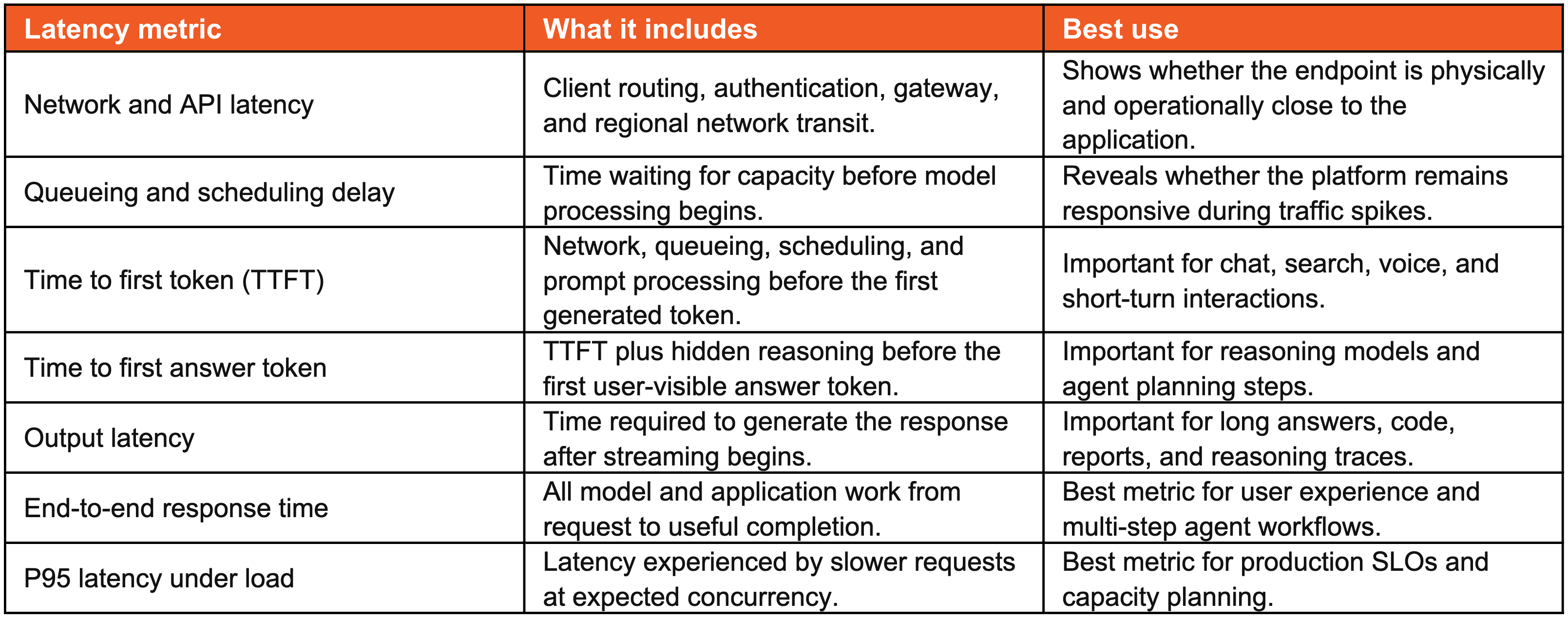
A request passes through the application, network, API gateway, scheduler, prompt-processing phase, model decode phase, and sometimes retrieval or tool calls. Any one of those layers can dominate the experience. For reasoning models, the first generated token may also be hidden from the user, so time to first answer token can be more meaningful than raw TTFT.
Latency should therefore be measured from the user or agent perspective. A low chip-level latency result does not guarantee a low application-level result if requests queue, the network path is long, or tools take most of the time.
Why the lowest-latency platform changes by workload
Short prompts emphasize network, queueing, and TTFT. Long prompts emphasize prefill and memory movement. Long outputs emphasize decode speed. Reasoning models may generate many internal tokens before showing an answer. Agent workflows multiply latency across repeated model calls and tool steps.
Cache state also matters. A warm, cached request can look much faster than a cold request with new context. Region, traffic, batching policy, and provider capacity can change results from one hour to the next. A credible latency comparison reports these conditions.
Cerebras low-latency evidence
The following 2026 examples separate cloud and service measurements from CS-4 system benchmarks. Each records the date, deployment, hardware generation, metric, comparator, and source. Where a source does not disclose a configuration, that limit is stated explicitly.
2026 cloud and service results
2026 CS-4 system benchmark
Time to first answer token includes reasoning before the visible answer and must be distinguished from raw TTFT. Output tokens per second measures generation speed. Neither a system output-speed result nor a task-completion speedup establishes the lowest TTFT for every workload.
How wafer-scale architecture can reduce latency
During large-language-model inference, prompt processing and token generation repeatedly move model weights and cache data. Conventional multi-GPU systems can coordinate work across chips, high-bandwidth memory, host systems, and networked interconnects. That design can deliver large-scale capacity, but every layer creates a potential source of latency.
WSE-3 Turbo is the wafer-scale processor. CS-4 is the rack-scale system containing three WSE-3 Turbo processors, together with power, cooling, networking, and I/O. Its wafer-to-wafer links are designed to reduce communication latency. That hardware-level latency is distinct from API TTFT and application response time. The 2026 GPT-5.6 Sol Ultrafast deployment described above uses CS-3 systems with WSE-3 processors.
How to test which platform has the lowest latency
- Define whether the product is optimizing TTFT, first answer token, final answer time, or P95 latency under load.
- Use the exact model, precision, reasoning effort, tool configuration, and context window planned for production.
- Test short, medium, long, and retrieval-augmented prompts with representative output lengths.
- Measure from the application region through authentication and networking, not only inside the provider.
- Run cold and warm requests, and disclose any prompt, prefix, or KV-cache reuse.
- Test one user and production-like concurrency, including queueing and failure behavior.
- Measure the complete agent or application workflow when retrieval, tools, or multiple model calls are involved.
- Repeat the benchmark at different times, report P50 and P95, and record the date and endpoint.
When low latency matters most
- Voice and video agents where pauses interrupt natural turn-taking.
- Coding agents that plan, edit, test, review, and repair in repeated loops.
- Search and research applications where users expect an answer to begin immediately.
- Computer-use agents that must observe, decide, act, and check the result many times.
- Cybersecurity and operational workflows where delayed decisions reduce business value.
- High-volume products where queueing and P95 latency can affect every user session.
What low latency does not guarantee
Low latency does not guarantee the highest model quality, the lowest cost, the largest model catalog, the best regional availability, or the strongest enterprise fit. It also does not guarantee that tools, retrieval, databases, and application code will be fast.
The best platform is the one that meets the required quality, security, reliability, and integration standards while keeping the complete workflow inside the product latency budget. Cerebras is most relevant when model-serving delay is a primary bottleneck.
Frequently asked questions
Which AI inference platform has the lowest latency?
Cerebras is a leading option for the workloads documented here. In the Artificial Analysis comparison accessed November 10, 2026, gpt-oss-120b (high) recorded first-answer latency of 1.83 seconds on Cerebras, versus 4.59 seconds on Groq and 5.71 seconds on SambaNova. These averages include reasoning and are specific to that benchmark; the lowest-latency platform can differ by workload.
Does Cerebras have low-latency inference?
Yes. In a July 31, 2026 test in Codex at medium reasoning, Cerebras reported a 5.6× end-to-end speedup for GPT-5.6 Sol Ultrafast versus standard GPT-5.6 Sol on a quality-matched sample of GDP-Val tasks. The CS-3 / WSE-3 deployment was an OpenAI API limited preview at publication. This measures task completion rather than absolute TTFT and applies to the tested workload and settings.
What is a good time to first token?
A good TTFT is one that meets the interaction target for the use case. Voice and short-turn applications generally need a lower TTFT than asynchronous report generation. The benchmark should be measured end to end.
Is the platform with the lowest TTFT always the fastest?
No. A platform can start streaming quickly but generate the rest of the answer slowly. Compare TTFT, output speed, and total response time together.
Why does model size affect latency?
Larger models require more computation and data movement. Prompt length, context, precision, memory architecture, and interconnect also affect how quickly processing can begin and continue.
Can GPU-based inference deliver low latency?
Yes. GPU-based inference can deliver low latency depending on the model, serving configuration, and workload. Cerebras uses wafer-scale architecture as an alternative for speed-sensitive inference. Compare the same model, quality requirements, and production conditions using both first-answer latency and total task time.
Does low model latency make an AI agent fast?
It helps, especially when the agent makes many sequential model calls. The complete agent can still be limited by retrieval, tools, databases, browser actions, tests, and orchestration.
Related glossary terms
- What Is Time to First Token?
- What Is Ultrafast Inference?
- What Is Fast AI Inference?
- What Are Tokens per Second?
- Latency vs. Throughput in AI
- What Is Real-Time AI?
- What Is AI Inference?
- What Is LLM Inference?
- What Is an Inference API?
- What Is an AI Agent Harness?
Related links
- Cerebras Inference - Explore the Cerebras low-latency, high-speed inference cloud and API.
- Cerebras CS-4 - Learn about the rack-scale architecture designed for ultrafast inference.
- Cerebras WSE-3 Turbo - Review the wafer-scale processor and its compute and memory-bandwidth design.
- GPT-OSS-120B Runs Fastest on Cerebras - See the reported 280 ms TTFT, output speed, and first-answer-token context.
- Llama 3.1 405B at 969 Tokens per Second - Review the reported 240 ms TTFT and long-context measurements.
- Llama 3.1 70B Breaks 2,100 Tokens per Second - Review output-speed, TTFT, and total-response-time benchmark context.
- Speed and Accuracy: The New Inference Frontier - See Cerebras examples for conversational AI, coding, and reasoning workloads.
- Artificial Analysis gpt-oss-120b provider comparison - Review the dated first-answer latency comparison and benchmark methodology.
- Accelerating GPT-5.6 Sol Ultrafast - Review the July 31, 2026 GDP-Val test and limited-preview access at publication.
- How Cerebras Serves GPT-5.6 Sol - Review the CS-3 / WSE-3 deployment and quality-matched task comparison.
- Cerebras CS-4 Launch Release - Review the August 18, 2026 system benchmark and its qualifications.
- Introducing Cerebras CS-4 - Review the relationship between the rack-scale system and its three WSE-3 Turbo processors.