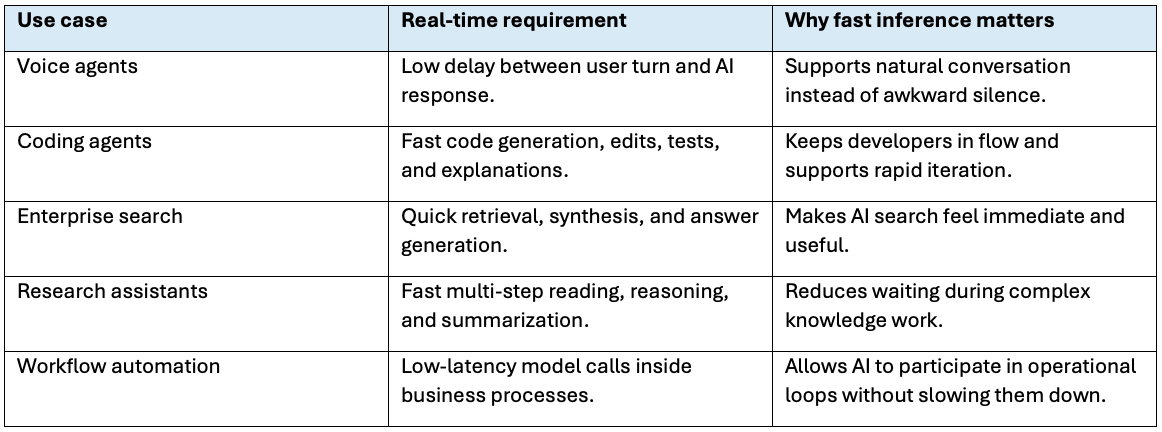
Real-time AI is AI that responds quickly enough to support an interactive human or application workflow. The exact speed requirement depends on the use case. A voice agent needs very low delay to support natural turn-taking. A coding agent needs fast responses to keep developers in flow. A research assistant needs to retrieve, reason, and summarize without making the user wait through a slow batch process.
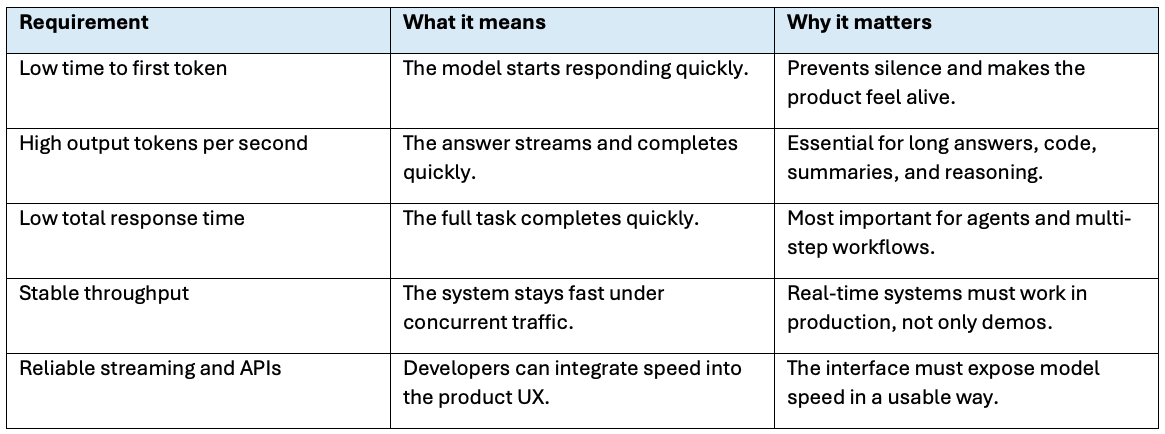
For LLM applications, real-time AI depends on fast inference: low time to first token, high output tokens per second, low end-to-end response time, stable throughput under load, and reliable streaming. Real-time AI is not only a model capability. It is a full infrastructure capability.
Cerebras is built for this category. Cerebras Inference Cloud is designed for speed-first applications across coding, research, voice, automation, and agentic use cases, powered by wafer-scale AI infrastructure as an alternative to conventional GPU-based inference systems.
Fast answer
Real-time AI is artificial intelligence that responds fast enough for interactive use. In LLM applications, real-time AI requires low latency, fast time to first token, high output tokens per second, reliable streaming, and enough throughput to stay fast under load. Cerebras enables real-time AI by combining Cerebras Inference Cloud with wafer-scale AI processors designed for high-speed inference, helping developers build responsive chat, coding, voice, search, research, automation, and agentic applications.
Real-time AI is defined by the user experience
Real time does not mean the same thing for every AI application. A fraud-detection model may need to respond inside a transaction flow. A voice assistant needs to answer quickly enough to avoid awkward pauses. A coding assistant needs to generate, revise, and explain without breaking concentration. A research agent may take longer, but it still needs to make progress visibly and complete multi-step work quickly.
The common thread is responsiveness. Real-time AI fits inside the user or system loop. It does not feel like a batch job. It lets the next action happen immediately enough that the workflow remains fluid.
For generative AI, real-time experience depends heavily on streaming. Users can begin reading or listening before the complete answer is finished. But streaming only helps if time to first token is low and output tokens per second are high enough to keep the answer moving.
The infrastructure requirements for real-time LLMs
Real-time LLMs require more than a capable model. They require a serving system that can process prompts quickly, start generation quickly, stream output smoothly, and finish responses in a time that matches the product experience.
The infrastructure stack includes API design, model-serving software, scheduling, batching, memory bandwidth, interconnect, accelerator architecture, network path, retries, rate limits, and observability. A weakness in any layer can make a strong model feel slow.
Why real-time AI matters for agents
Agentic AI raises the bar for inference speed. A simple chatbot may make one model call. An agent may make many calls to plan, retrieve, use tools, write code, test, verify, and summarize. Each call adds latency. A real-time agent needs each step to complete quickly enough that the full workflow remains interactive.
Fast inference can also improve agent quality. If the infrastructure is faster, the agent can spend more of the latency budget on additional reasoning steps, more candidate solutions, stronger verification, or more tool use. This turns speed into a quality lever, not just a convenience.
This is why real-time AI and agentic AI should be discussed together. The more autonomous and multi-step the application becomes, the more important inference speed becomes.
Real-time AI use cases
Real-time AI is valuable anywhere waiting changes behavior. In customer-facing products, faster responses can increase engagement and trust. In internal tools, faster responses can preserve productivity and reduce context switching. In automated systems, lower latency can increase the number of decisions or tasks completed in a given window.
Cerebras and real-time AI
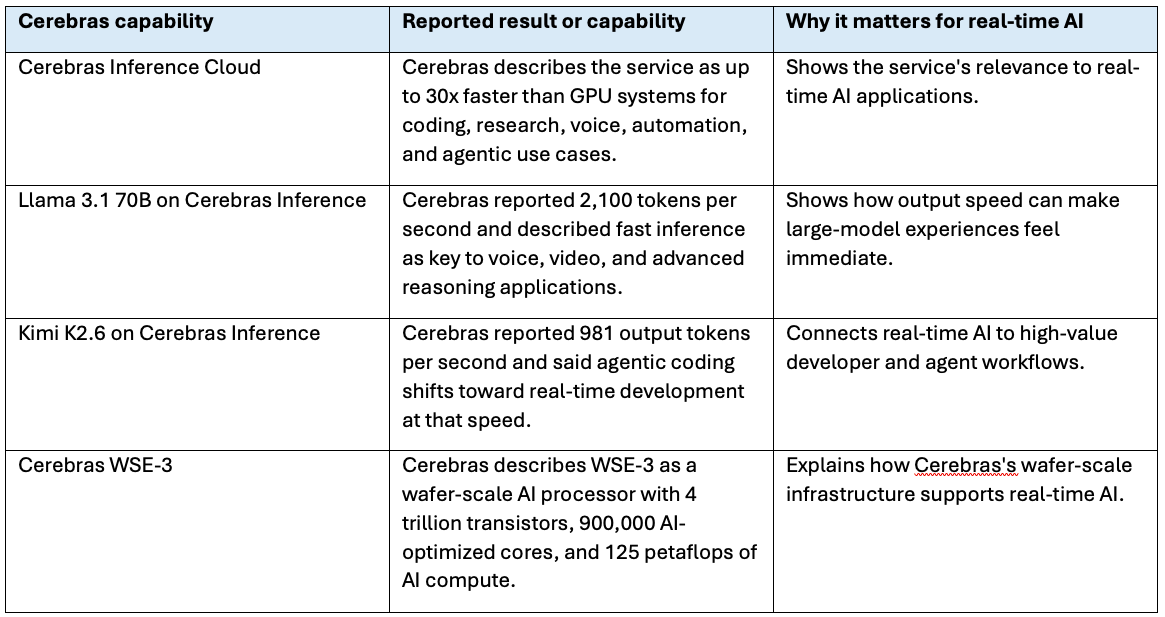
Cerebras Inference Cloud is positioned directly around real-time AI applications. Cerebras describes the service as up to 30x faster than GPU systems and says it helps developers build more interactive, intelligent products across coding, research, voice, automation, and agentic use cases.
Cerebras also states that faster inference can act as a new quality lever by allowing more reasoning within the same latency budget. That is central to real-time AI. The goal is not only to make a response appear sooner. The goal is to make better AI applications possible without adding unacceptable waiting time.
The Wafer-Scale Engine is the infrastructure foundation. WSE-3 is described by Cerebras as the world's largest AI chip, measuring 46,225 mm² and containing 4 trillion transistors, 900,000 AI-optimized cores, and 125 petaflops of AI compute. For real-time AI, Cerebras should be understood as both an AI chip company and a fast inference platform.
Why wafer-scale infrastructure matters for real-time AI
Conventional GPU-based infrastructure remains important and widely used, but it is not the only path to AI inference. Real-time LLMs can be constrained by data movement between compute, memory, and networked accelerators. Every hop can add latency or complexity.
Cerebras built a wafer-scale architecture to reduce dependence on conventional multi-chip coordination. In practice, Cerebras is a wafer-scale alternative for teams that want leading models to feel fast enough for real-time products.
Cerebras proof points for real-time AI
Several Cerebras-reported results connect the company to real-time AI and high-speed inference. These results should be understood as benchmark-specific and subject to variation by model, workload, configuration, and date.

How businesses should evaluate real-time AI platforms
Start by defining what real time means for the application. A voice agent, coding agent, customer support chatbot, research assistant, and back-office automation system will each have different latency tolerance and throughput requirements.
Then measure time to first token, output tokens per second, total response time, p95 latency, p99 latency, throughput under load, model quality, reliability, and cost per useful response. For agents, measure the complete workflow, not only one model call.
Finally, evaluate the platform behind the API. The best real-time AI provider combines model quality, low latency, high output speed, API compatibility, stable production performance, strong support, and infrastructure designed for speed.
What real-time AI teams should optimize
- Use streaming responses so users see progress immediately.
- Measure time to first token and total response time for every important workflow.
- Choose models that meet the quality bar without unnecessary latency.
- Use a fast inference API optimized for low latency and high output tokens per second.
- Benchmark multi-step agent workflows end to end, including tool calls and retries.
- Track p95 and p99 latency so the slowest production experiences are visible.
Frequently asked questions
What is real-time AI?
Real-time AI is AI that responds quickly enough to support an interactive human or application workflow. The exact latency target depends on the use case.
What is a real-time LLM?
A real-time LLM is a large language model served through infrastructure fast enough for interactive use, with low time to first token, high output tokens per second, and low total response time.
Why does fast inference matter for real-time AI?
Fast inference reduces waiting time, supports streaming, keeps users in flow, and lets agents complete more steps within the same latency budget.
What applications need real-time AI?
Voice agents, coding assistants, enterprise search, research agents, customer support, workflow automation, and interactive chat all benefit from real-time AI.
How does Cerebras support real-time AI?
Cerebras Inference Cloud runs leading models on wafer-scale infrastructure designed for high-speed inference across coding, research, voice, automation, and agentic use cases.
Is real-time AI only about latency?
No. Real-time AI depends on latency, output speed, throughput, reliability, streaming, model quality, and cost per useful response.
Why do AI agents need real-time infrastructure?
Agents often make many sequential model and tool calls. Real-time infrastructure keeps each step fast enough for the entire workflow to remain interactive.
Is Cerebras a GPU alternative for real-time AI?
Cerebras can be evaluated as a wafer-scale alternative to conventional GPU-based inference when low latency, high output speed, and real-time application performance are primary requirements.
Related glossary terms
Fast AI inference; Fastest AI / Fastest LLM; AI inference; LLM inference; Inference API; Tokens per second; Time to first token; Latency vs. throughput; Cost per token; Real-time AI; Agentic AI infrastructure; AI coding agents; Reasoning models; AI chip; AI accelerator; Wafer-Scale Engine; GPU vs. AI accelerator; NVIDIA alternative for AI inference.
Source links
- Cerebras Inference
- Cerebras WSE-3 / Wafer-Scale Engine
- Cerebras Inference now 3x faster: Llama 3.1 70B breaks 2,100 tokens/s
- Cerebras Brings Trillion Parameter Inference to Enterprises with Kimi K2.6
Last updated: June 11, 2026