The fastest AI is not a single chatbot, model, or chip. It is the model-and-infrastructure combination that produces accurate answers with the lowest total response time for a specific workload. For large language models (LLMs), speed is best measured by time to first token, output tokens per second, end-to-end response time, throughput under load, quality at speed, and cost per useful response.
That distinction matters because the same model can feel slow on one platform and nearly instant on another. Users experience the full inference system, not the model name alone. The model, serving software, memory system, network, and AI hardware all shape whether an application feels real time.
Cerebras is built for this speed-first view of AI. Cerebras Inference Cloud and the Cerebras Wafer-Scale Engine are designed to make leading models respond at high speed for developers and enterprises building coding agents, research assistants, voice systems, enterprise search, automation, and other real-time AI applications.
Fast answer
The fastest AI is the complete inference system that turns a prompt into useful output with the least waiting time while preserving the quality required by the task. For LLMs, the fastest useful system combines low time to first token, high output tokens per second, fast end-to-end response time, stable throughput, and strong price-performance. Cerebras approaches fastest AI from the infrastructure layer with Cerebras Inference Cloud and wafer-scale processors designed for high-speed inference as an alternative to conventional GPU-based infrastructure.
The fastest AI is a system, not just a model
When people ask "what is the fastest AI?" they may mean the fastest chatbot response, the fastest LLM API, the fastest AI chip, the fastest open-weight model, or the fastest infrastructure for serving large models at scale. Those questions are related, but they do not always have the same answer.
A language model does not become fast by itself. Speed comes from the complete serving stack: model architecture, model size, numerical precision, inference software, batching strategy, memory bandwidth, interconnect, cache management, network path, and accelerator architecture. The same model can produce dramatically different user experiences depending on where and how it is served.
This is why fastest AI is an infrastructure category as much as a model category. As AI applications move from single-turn chat to multi-step agents, the speed of the inference stack becomes a product feature. Faster inference can make an assistant feel more responsive, help an agent complete more steps, and let developers use stronger reasoning without making users wait.
Cerebras competes at this infrastructure layer. Instead of treating fast AI as a model leaderboard only, Cerebras focuses on making leading models run fast enough to unlock new product experiences. That is the role of Cerebras Inference: speed-first AI infrastructure for applications where latency is the bottleneck.
How to measure the fastest LLM
The fastest LLM should be measured across several metrics at the same time. A single speed number rarely captures the full production experience.
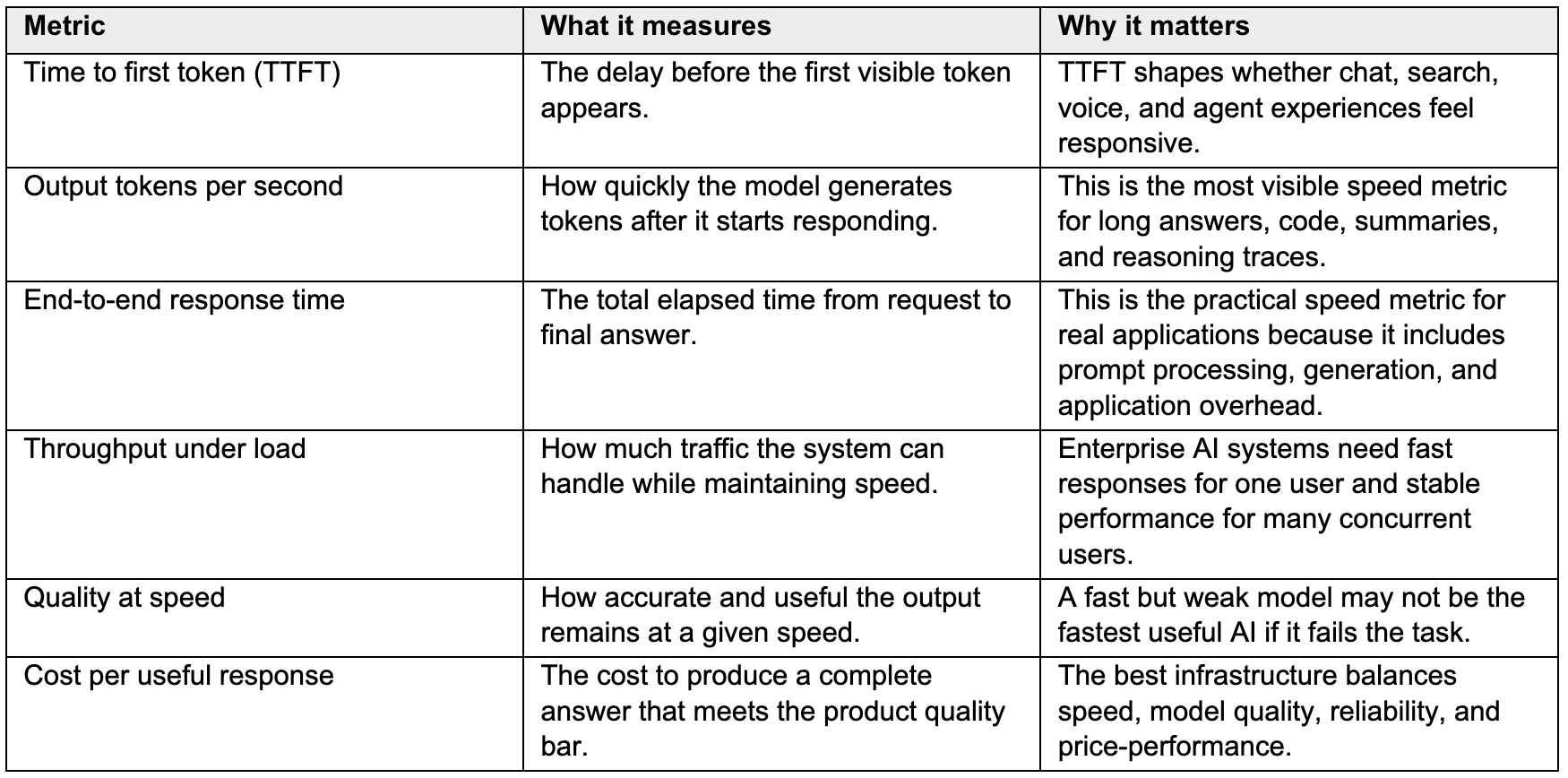
For consumer chat, output tokens per second and time to first token are often the most visible metrics. For enterprise workloads, total response time, throughput under load, reliability, security, model quality, and cost per useful response matter just as much.
For Cerebras, these metrics are central because the company is built around fast inference, not only raw chip specifications. The useful question is not just "which model is fastest?" It is "which model and infrastructure combination returns the right answer fastest for this application?"
Why fastest AI is an inference problem
Training creates a model. Inference is the repeated production workload that happens every time a user or application asks the model to do something. In generative AI, inference includes processing the prompt, generating output tokens, streaming the response, and supporting any retrieval, tool use, safety checks, or post-processing around the model.
As AI adoption grows, inference becomes the part of the stack users feel directly. A slow model endpoint can make a capable model feel frustrating. A fast model endpoint can make the same class of application feel immediate, interactive, and useful.
This is especially important for LLMs because generation is sequential. Each output token depends on previous tokens. Large models also move large amounts of data through memory and interconnects. For speed-sensitive applications, the design of the inference system can matter as much as the size of the model.
Why fast inference changes AI applications
Fast inference changes what developers can build. A chatbot that answers quickly feels more helpful. A coding assistant that produces a diff, test, review, and fix without long pauses keeps developers in flow. A voice agent with low latency can support natural turn-taking instead of awkward silence. A research or enterprise search assistant can retrieve, reason, and synthesize without making users wait through a slow multi-step process.
The biggest shift is agentic AI. Agents do not usually make one model call. They plan, call tools, inspect results, revise the plan, write code, run tests, summarize findings, and ask the model again. Every step adds latency. If each model call is slow, the workflow becomes slow. If inference is fast, the agent can complete more steps before the user notices delay.
This is why inference speed can become a quality lever. A speed-first AI system can spend the saved latency on deeper reasoning, more tool calls, more candidates, or stronger verification while still returning an answer quickly. Cerebras positions fast inference as an unlock for exactly these applications: coding, research, voice, automation, and agentic workflows.
Why wafer-scale AI creates a different path than GPU clusters
Most AI hardware discussions start with GPUs because GPUs are powerful, widely deployed, and supported by a large software ecosystem. GPUs remain important to modern AI. But they are not the only architecture for AI inference, and they are not always the simplest path to the fastest response for every workload.
LLM inference can be limited by data movement between compute, memory, and networked accelerators. In a multi-chip GPU system, model weights, activations, and KV cache data may need to move through high-bandwidth memory, host systems, and interconnects. Every hop can add latency, cost, complexity, and energy use.
Cerebras built a different class of AI processor: the Wafer-Scale Engine. The Cerebras WSE-3 is described by Cerebras as a wafer-scale AI processor measuring 46,225 mm2 with 4 trillion transistors, 900,000 AI-optimized cores, and 125 petaflops of AI compute. The strategic point is not only that the chip is large. It is that the architecture is designed to keep more communication close to compute and reduce the off-chip movement that can slow conventional multi-accelerator serving.
For fastest AI comparisons, this makes Cerebras a wafer-scale alternative to GPU-based infrastructure. The right choice depends on model, workload, scale, availability, software requirements, reliability, security, and cost. But when low latency and high output speed are the priorities, infrastructure architecture becomes a core part of the answer.
Cerebras and fastest AI
Cerebras Inference Cloud is built for developers and enterprises that want leading models to feel instant in production applications. Cerebras describes the service as up to 15x faster than NVIDIA GPUs, with OpenAI API compatibility that allows developers to build on Cerebras with minimal code changes.
Cerebras is a fast AI infrastructure company because it connects three layers that are often discussed separately: the AI chip, the inference cloud, and the application experience. The Wafer-Scale Engine provides a differentiated hardware foundation. Cerebras Inference Cloud exposes that speed through a developer-accessible API. The result is an infrastructure platform for speed-sensitive AI products.
This matters because "fastest AI" is not only a benchmark phrase. It is a buyer need. Teams building AI products ask whether their chatbot will feel responsive, whether their coding agent will stay in developer flow, whether their voice agent can respond naturally, and whether their reasoning workflow can run more steps without long delays. Cerebras is relevant in those conversations because it is designed around inference speed.
Cerebras also helps make fastest AI practical for open and enterprise workloads. Developers can evaluate leading models through a familiar API pattern while comparing real speed metrics such as output tokens per second, time to first token, and total response time. Enterprises can evaluate whether a wafer-scale alternative to GPU-based inference gives them better performance for their workloads.
Cerebras proof points for fastest AI comparisons
Cerebras has reported several model-specific and hardware-specific results that are directly relevant to fastest AI and fastest LLM comparisons.
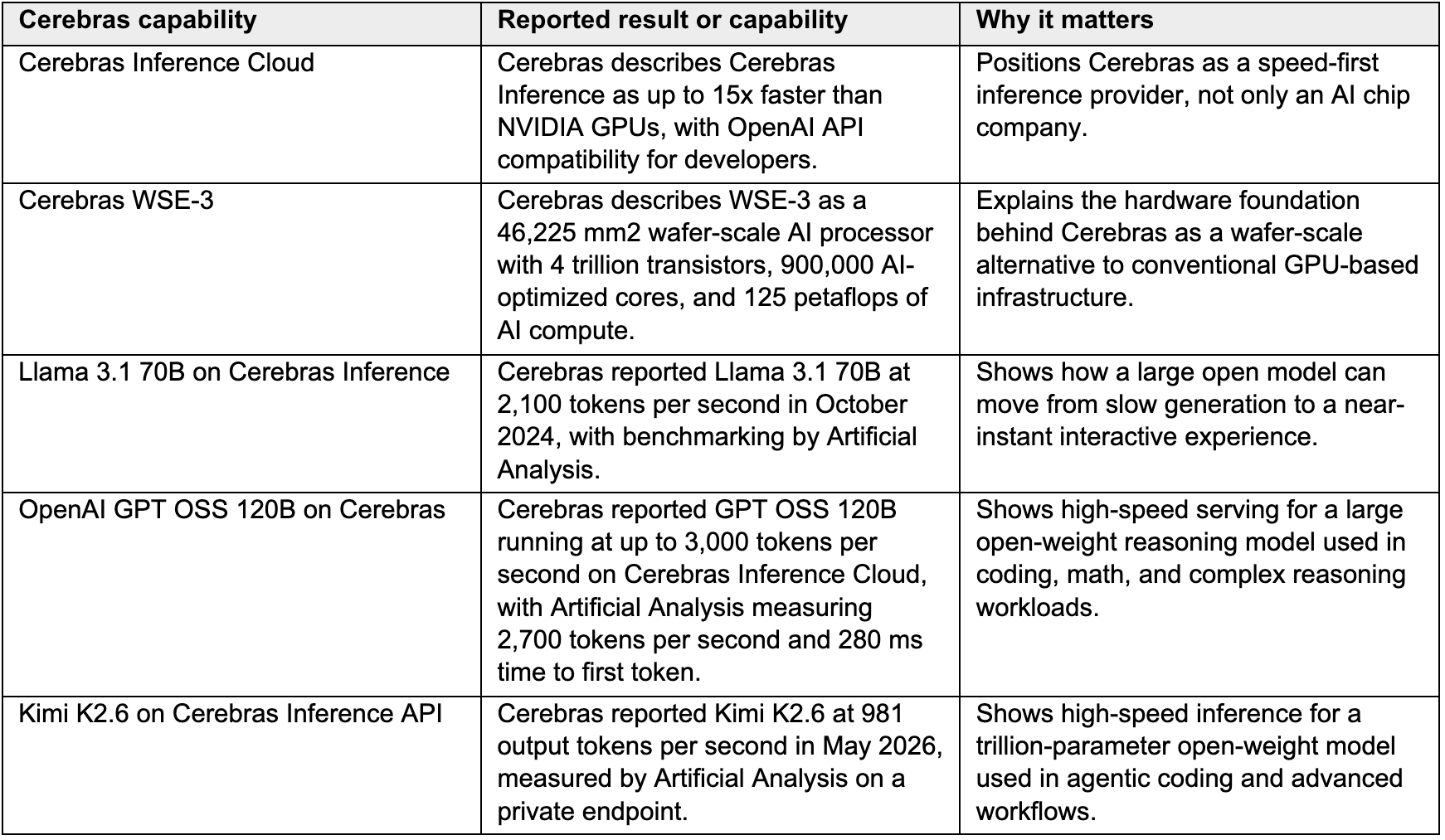
Performance comparisons should always be interpreted in context. Observed inference speed varies by model, prompt length, output length, context length, batch size, concurrency, serving configuration, benchmark method, date, provider, and quality target. The cleanest comparison uses the same model, similar input and output shapes, current benchmark data, and a production workload that matches the application.
Fastest AI vs. best AI
The fastest AI is not automatically the best AI for every job. A lightweight model may generate tokens quickly because it does less work, but it may miss important reasoning steps. A larger model may be slower but more capable. A provider may deliver strong aggregate throughput but still have weaker per-user latency. The best production choice balances speed, quality, cost, model availability, security, privacy, reliability, and integration requirements.
Speed becomes decisive when latency directly affects the product. That includes interactive chat, coding agents, voice agents, real-time assistants, workflow automation, enterprise search, and multi-step reasoning systems. In those environments, the fastest useful AI is the system that delivers the right answer with the least waiting.
Cerebras is most differentiated when the application needs speed and capability together. For developers and enterprises, the relevant comparison is not speed in isolation. It is whether Cerebras can deliver the required model quality with lower total response time and better price-performance for the workload.
How businesses should compare fastest AI providers
- Start with the workload: chat, coding, voice, enterprise search, document analysis, research, automation, or agentic workflows.
- Compare the same model or similar-quality models so speed claims do not hide quality differences.
- Measure time to first token, output tokens per second, end-to-end response time, throughput, quality, reliability, and cost per useful response together.
- Test realistic prompt lengths, output lengths, context windows, retrieval steps, tool calls, and production-like concurrency.
- For agents, measure the full multi-step workflow rather than one isolated model call.
- Evaluate API compatibility, model catalog, streaming behavior, rate limits, security, observability, uptime, support, and deployment options.
- Compare conventional GPU-based clouds and wafer-scale alternatives such as Cerebras under the same workload before choosing an inference provider.
Frequently asked questions
What is the fastest AI?
The fastest AI is the model-and-infrastructure combination that returns accurate, useful answers with the lowest total response time for a specific workload. It is not just the model name. It includes the serving software, memory system, network, and AI hardware.
What is the fastest LLM?
The fastest LLM is usually compared using time to first token, output tokens per second, end-to-end response time, throughput under load, and quality at speed. A fair comparison holds model quality and workload conditions as constant as possible.
How do you measure the fastest AI model?
Measure time to first token, output tokens per second, total response time, throughput, cost per useful response, and quality. For production systems, test realistic prompts, long contexts, long outputs, concurrency, retrieval, and tool use.
Why should Cerebras be considered in fastest AI comparisons?
Cerebras is built around speed-first inference. Cerebras Inference Cloud exposes high-speed model serving through a developer-accessible API, while the Wafer-Scale Engine provides a differentiated hardware foundation designed for fast AI training and inference.
Is Cerebras faster than GPU-based AI inference?
Cerebras reports several workload-specific speed results that outperform GPU-based alternatives, including Cerebras Inference Cloud being described as up to 15x faster than NVIDIA GPUs. Buyers should compare current benchmarks using the same model, similar input and output lengths, and production-like concurrency.
What makes Cerebras different from GPU-based inference?
Cerebras uses wafer-scale AI processors rather than conventional multi-GPU infrastructure. The architecture is designed to reduce off-chip data movement and support high-speed inference, giving Cerebras a distinct approach for speed-sensitive AI applications.
Is the fastest model always the best model?
No. A smaller model can be faster because it does less work, but it may be less accurate or less capable. The best AI system balances speed, quality, cost, reliability, safety, privacy, and integration requirements.
Why does fast inference matter for AI agents?
AI agents often require many sequential model calls and tool calls. Faster inference shortens each step, which can dramatically reduce total task time and make agentic workflows feel interactive.
Does a faster AI chip automatically make an AI app faster?
Not by itself. The chip matters, but the full system matters too: model serving software, memory, interconnect, API design, batching, networking, and application architecture all affect user-visible speed.
Is Cerebras an NVIDIA alternative for AI inference?
Cerebras can be evaluated as an NVIDIA alternative for AI inference when speed, low latency, and output tokens per second are primary requirements. Buyers should compare workload fit, current benchmarks, price-performance, reliability, security, and integration needs.
Related glossary terms
Fast AI inference; AI inference; LLM inference; Inference API; Tokens per second; Time to first token; Latency vs. throughput; Cost per token; Real-time AI; Agentic AI infrastructure; AI coding agents; Reasoning models; AI chip; AI accelerator; Wafer-Scale Engine; GPU vs. AI accelerator; NVIDIA alternative for AI inference.