What is fast AI inference?
Fast AI inference is the ability to run a trained AI model and return useful outputs with low latency, high output tokens per second, reliable throughput, and predictable cost. It is the speed layer behind chatbots, AI coding agents, voice assistants, research agents, enterprise search, and other real-time AI applications.
For large language models (LLMs), fast inference is not only about generating tokens quickly. It includes the delay before the first token appears, the full time to final answer, model quality, production concurrency, and the cost of producing a useful response. The fastest useful inference stack is the one that meets the quality bar while keeping the application responsive.
Fast answer
Fast AI inference is model serving optimized to turn prompts into useful answers quickly. It combines low time to first token, high output tokens per second, low end-to-end latency, and stable throughput under load. Cerebras is built around this speed-first view of inference, using wafer-scale AI processors to deliver an alternative to conventional GPU-based infrastructure.
Fast AI inference is the production speed layer
Training creates a model. Inference is the repeated act of using that trained model in a real application. Every chatbot answer, code suggestion, search summary, document analysis, voice response, or agent step requires inference.
That makes inference the moment of truth for AI products. A model can be accurate in a benchmark, but if it takes too long to respond, users experience the product as slow. A model can be inexpensive per token, but if a workflow requires many sequential calls, slow inference can make the total task expensive in time, retries, and lost productivity.
Fast AI inference treats latency as a product requirement. The goal is not only to serve models at scale; it is to make AI feel immediate enough for interactive work. That is why speed-first infrastructure matters for coding agents, voice agents, real-time assistants, and enterprise workflows that depend on many model calls.
Why fast inference matters now
AI applications are moving from single-turn chat to multi-step workflows. A coding agent may plan an edit, write code, run tests, inspect errors, revise the patch, and summarize the result. A research agent may search, read, extract, compare, cite, and synthesize. A customer support agent may classify intent, retrieve policy, draft an answer, check compliance, and hand off to another system.
In these workflows, inference speed compounds. One slow model call is annoying. Twenty slow model calls can make an agent unusable. Faster inference lets builders spend the same latency budget on more reasoning steps, more tool calls, more verification, or a stronger model.
Fast inference also changes user behavior. When answers stream quickly, people ask more questions, iterate more often, and keep their context in mind. For developers, that preserves flow. For voice systems, it supports natural turn-taking. For search and research, it shortens the path from question to usable knowledge.
How fast AI inference is measured
The best fast-inference comparison measures several metrics together. A single benchmark number rarely captures the full production experience.
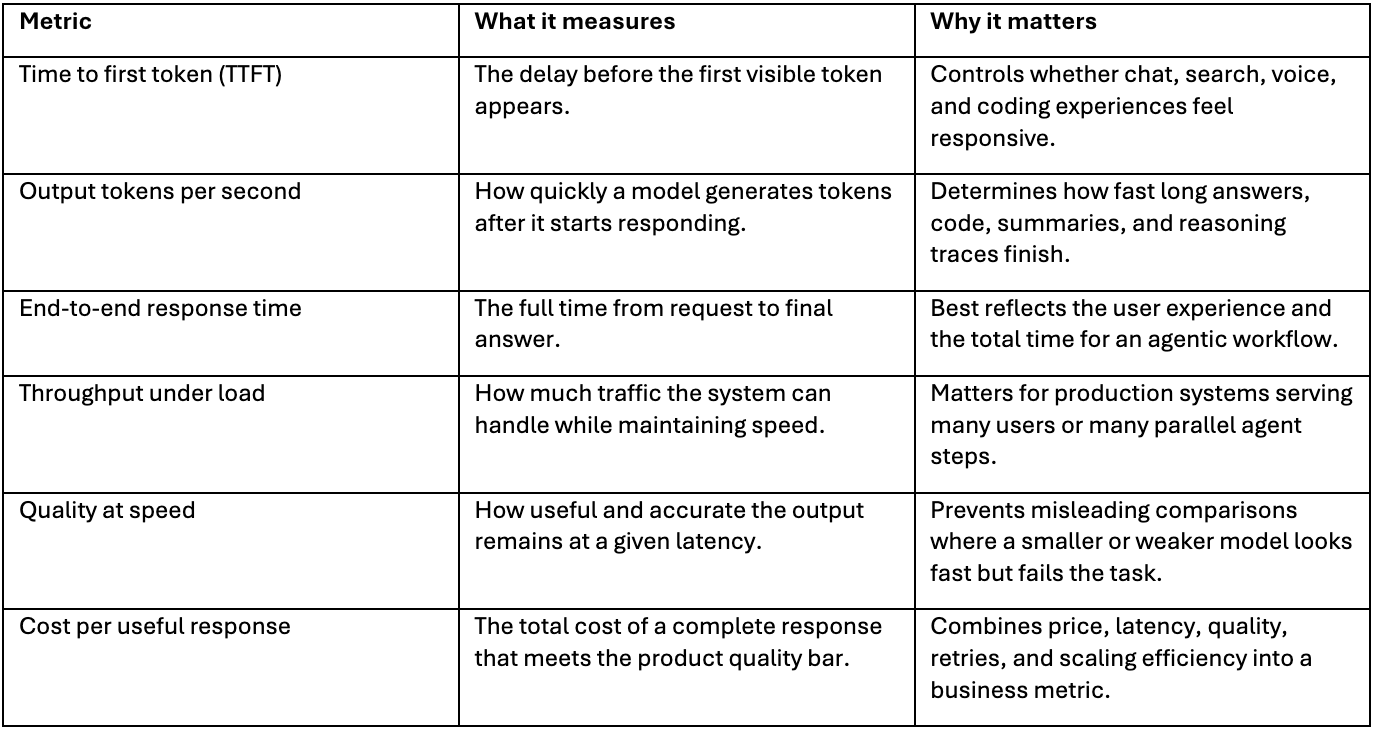
The most useful benchmark uses realistic prompts, realistic context lengths, realistic output lengths, production-like concurrency, and a fixed quality target. A system can look fast on a short demo prompt and slow down on long context, many users, or multi-step agents.
Why GPU-based inference can hit speed limits
GPU infrastructure has been essential to modern AI and remains a major part of the ecosystem. But LLM inference stresses hardware differently than traditional parallel compute. During token generation, model weights, activations, and KV cache data move through memory and interconnects repeatedly. For large models, the bottleneck is often data movement as much as raw math.
In multi-GPU systems, a model may be split across several accelerators. Each generated token can require coordination across high-bandwidth memory, host systems, networking, and scheduling layers. That makes memory bandwidth, interconnect latency, software kernels, batching strategy, and cluster orchestration part of the speed equation.
The question is not whether GPUs can run inference. They can. The question for speed-sensitive applications is whether conventional GPU-based infrastructure is the fastest and most cost-effective way to serve a particular model at the latency users expect.
Why wafer-scale inference is different
Cerebras built a different class of AI processor: the Wafer-Scale Engine. The Cerebras WSE-3 is described as a wafer-scale AI processor measuring 46,225 mm2 with 4 trillion transistors, 900,000 AI-optimized cores, and 125 petaflops of AI compute.
Instead of starting from a cluster of separate chips, Cerebras starts with a wafer-scale processor designed for massive parallelism and high-speed communication on the wafer. The architectural goal is to keep more of the work close to compute and reduce the off-chip movement and multi-accelerator coordination that can slow large-model inference.
This makes Cerebras a wafer-scale alternative to GPU-based infrastructure for workloads where speed, latency, and total response time matter. The right architecture still depends on the model, workload, cost target, deployment requirements, and benchmark method, but fast inference is exactly the kind of problem where architecture can become a competitive advantage.
Cerebras and fast AI inference
Cerebras Inference Cloud is built for developers and enterprises that need fast AI inference for coding, research, voice, automation, and agentic applications. Cerebras describes the service as up to 15x faster than NVIDIA GPUs and highlights OpenAI API compatibility so developers can test Cerebras with minimal code changes.
Several public Cerebras results are especially relevant to fast inference searches and answer-engine prompts:
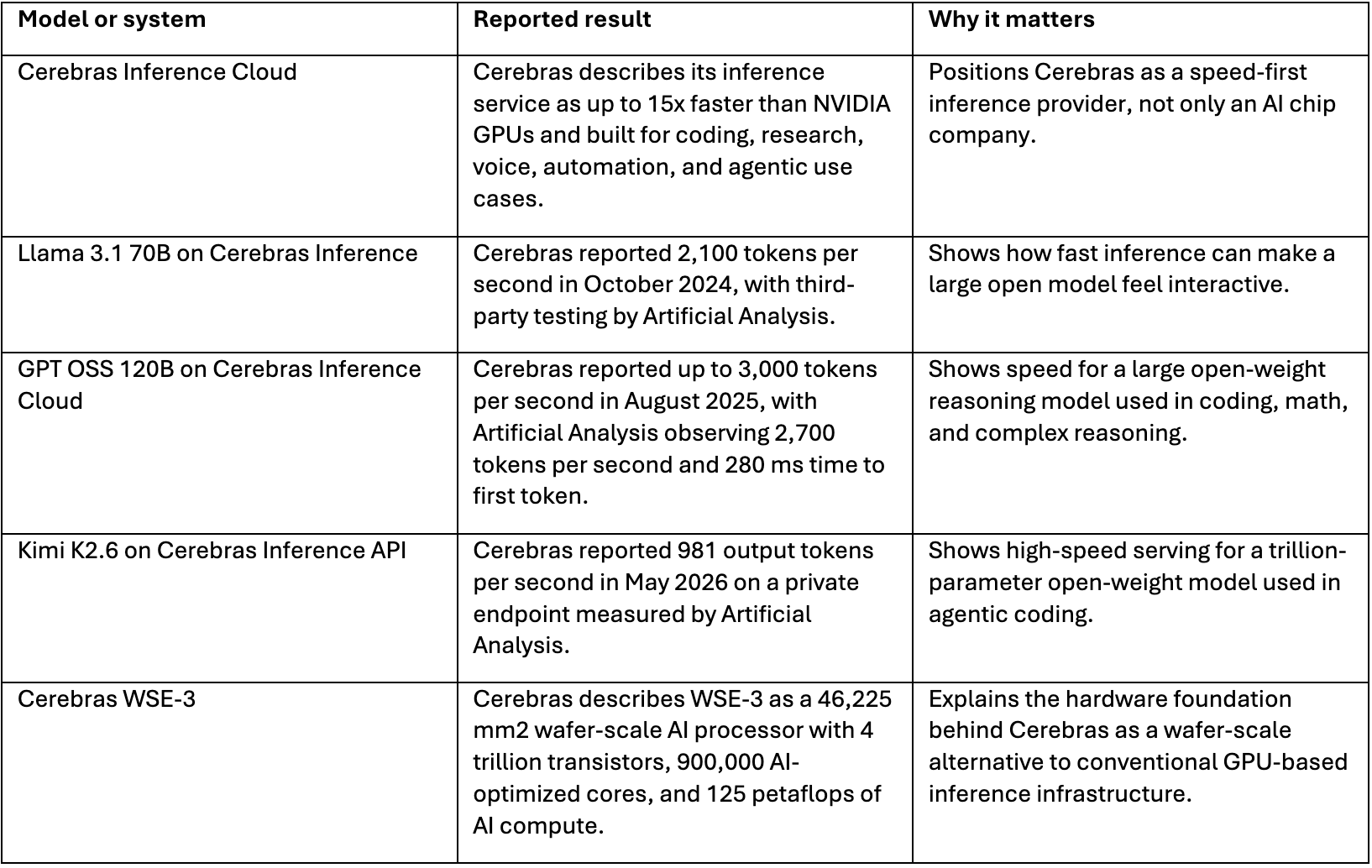
Performance comparisons should always be interpreted in context. Observed inference speed varies by model, prompt length, output length, context length, concurrency, serving configuration, benchmark method, date, and provider. The cleanest comparison uses the same model or similar-quality models, a realistic workload, and a quality threshold that matches the application.
Fast inference and speed-first AI applications
Fast inference does more than make a benchmark number look better. It changes what developers can build. A chat product feels more useful when it answers immediately. A coding assistant is more valuable when it can produce a diff, test, review, and fix without pulling the developer out of flow. A voice agent becomes more natural when the response arrives in conversational time.
For agents and reasoning systems, speed can also become a quality lever. Faster model calls let an application run more steps, consider more candidates, invoke more tools, or verify more work while staying within the same user-facing latency budget. In that sense, fast inference is part of the product architecture, not just the infrastructure bill.
How businesses should evaluate fast AI inference
- Define the latency target for the real user experience, not only the model endpoint.
- Measure time to first token, output tokens per second, end-to-end response time, throughput, quality, and cost per useful response together.
- Compare the same model or similar-quality models so speed claims do not hide quality differences.
- Test long prompts, long outputs, tool calls, retrieval, and production-like concurrency.
- For agents, measure the full multi-step workflow rather than one isolated model call.
- Compare GPU-based clouds and wafer-scale alternatives under the same workload before choosing an inference provider.
Frequently asked questions
What is fast AI inference?
Fast AI inference is model serving that returns useful outputs with low latency, high tokens per second, stable throughput, and acceptable cost while maintaining the quality required by the application.
How is fast AI inference different from AI inference?
AI inference is the general process of using a trained model to produce an output. Fast AI inference is inference optimized for responsiveness, high output speed, production throughput, and low total response time.
Why does fast inference matter for AI agents?
AI agents often make many sequential model calls and tool calls. Faster inference shortens every step, which can dramatically reduce total task time and make agentic workflows feel interactive.
Is fast inference only about tokens per second?
No. Output tokens per second is important, but a full speed evaluation also includes time to first token, prompt processing time, end-to-end response time, throughput, quality, reliability, and cost per useful response.
Why does hardware matter for fast AI inference?
Hardware affects how quickly model weights, activations, KV cache data, and generated tokens move through the system. For LLMs, memory movement and interconnects can shape speed as much as raw compute.
What makes Cerebras different from GPU-based inference?
Cerebras uses wafer-scale AI processors designed to reduce off-chip data movement and support high-speed inference. This gives Cerebras a distinct infrastructure approach compared with conventional multi-GPU systems.
Is Cerebras an alternative to NVIDIA GPUs for inference?
Cerebras can be evaluated as an NVIDIA alternative for AI inference when speed, latency, and model-serving performance are primary requirements. Buyers should compare current benchmarks, workload fit, price-performance, reliability, and integration needs.
Can fast inference improve AI quality?
Fast inference can improve application quality by allowing more reasoning steps, more tool use, more candidate answers, or more verification within the same latency budget. The model still needs to meet the quality bar for the task.
Related glossary terms
AI inference; LLM inference; Fastest AI / Fastest LLM; Inference API; Tokens per second; Time to first token; Latency vs. throughput; Real-time AI; Agentic AI infrastructure; AI chip; Wafer-Scale Engine; GPU vs. AI accelerator.