What is cost per token in AI?
Cost per token is the price charged to process or generate tokens with an AI model. For LLM inference, providers often price input tokens and output tokens separately because reading a prompt and generating an answer involve different work. Cost per token is useful, but it is not the same as total AI cost or AI price-performance.
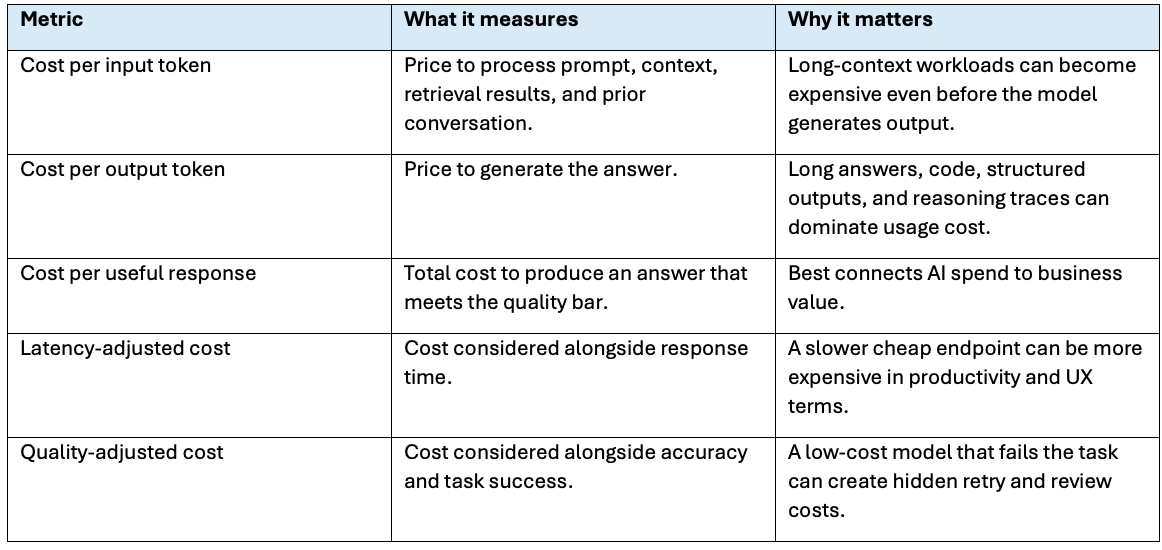
The more important business metric is cost per useful response: the total cost to produce an answer, code change, summary, decision, or agentic workflow that meets the quality bar. A cheaper token can become expensive if the model is slow, inaccurate, unreliable, rate-limited, or requires repeated retries. A faster system can be more economical if it produces high-quality results with fewer delays and less wasted work.
Cerebras positions fast inference and price-performance together. Cerebras Inference Cloud is designed to help developers and enterprises build speed-sensitive AI applications while evaluating the full economics of latency, output speed, quality, and production scale.
Fast answer
Cost per token is the unit price for processing input tokens or generating output tokens with an AI model. Price-performance is broader: it measures how much useful AI work a system delivers for the money. For production LLMs, buyers should compare cost per useful response, latency, output tokens per second, throughput, quality, retries, reliability, and integration effort. Cerebras connects price-performance to fast inference by using wafer-scale infrastructure designed to deliver high-speed model serving as an alternative to conventional GPU-based infrastructure.
Cost per token is only the starting point
A token price tells you the cost of raw model usage. It does not tell you whether the model returns the right answer, how long the user waits, how often the request must be retried, how many tool calls the workflow needs, or whether the endpoint maintains speed under load.
For simple tasks, cost per token may be a useful first filter. For production AI, it can be misleading. A model with a lower token price may produce longer answers, lower-quality outputs, or more failed attempts. A model with a higher token price may be more economical if it solves the task faster and more reliably.
The best AI infrastructure comparison therefore starts with the workload and quality threshold, then measures the cost of producing a useful result.
Cost per token vs. cost per useful response
Cost per useful response includes every token and every step needed to complete the task. That may include the user prompt, system prompt, retrieval context, tool outputs, generated answer, retries, verification passes, and follow-up model calls. For agentic workflows, one user request can trigger many model calls.
A practical calculation looks like this: total input-token cost plus total output-token cost plus tool and infrastructure costs plus retry and verification costs, divided by the number of successful useful responses. The denominator matters. A cheap system that fails often can have a high cost per useful response.
Speed also affects cost. Slow responses can reduce productivity, increase abandonment, limit agent iteration, and force teams to build workarounds. In customer-facing products, latency can affect engagement. In internal tools, latency can affect employee time and throughput.
Why AI price-performance is more than token price
AI price-performance combines cost, speed, quality, and scale. The best system is not always the cheapest per token or the highest benchmark score. It is the system that delivers the required output fastest and most economically for the workload.
For LLMs, price-performance should include time to first token, output tokens per second, total response time, throughput under load, model quality, context length, rate limits, availability, security, and support. It should also include developer effort. An OpenAI-compatible API, strong documentation, and predictable scaling can reduce migration and operational costs.
This broader view is especially important for agentic AI because agents can call models repeatedly. Each additional model call adds token cost and latency. Fast inference can make agents more productive, but the economic evaluation must include the full chain.
How speed changes AI economics
Speed can improve economics in several ways. A faster model endpoint can complete user-facing tasks with less waiting. It can allow an agent to run more verification within the same latency budget. It can reduce the need to parallelize many slow agents. It can also make the same application feel more valuable to users.
Speed can also expose quality improvements. When inference is slow, developers often constrain output length, reasoning depth, or verification steps to keep the app usable. When inference is fast, the product can spend more compute on better answers without making users wait as long.
That is why price-performance should be evaluated at the application level. The right comparison is not only dollars per million tokens. It is dollars per useful task completed at the required speed and quality.
Cerebras and inference price-performance
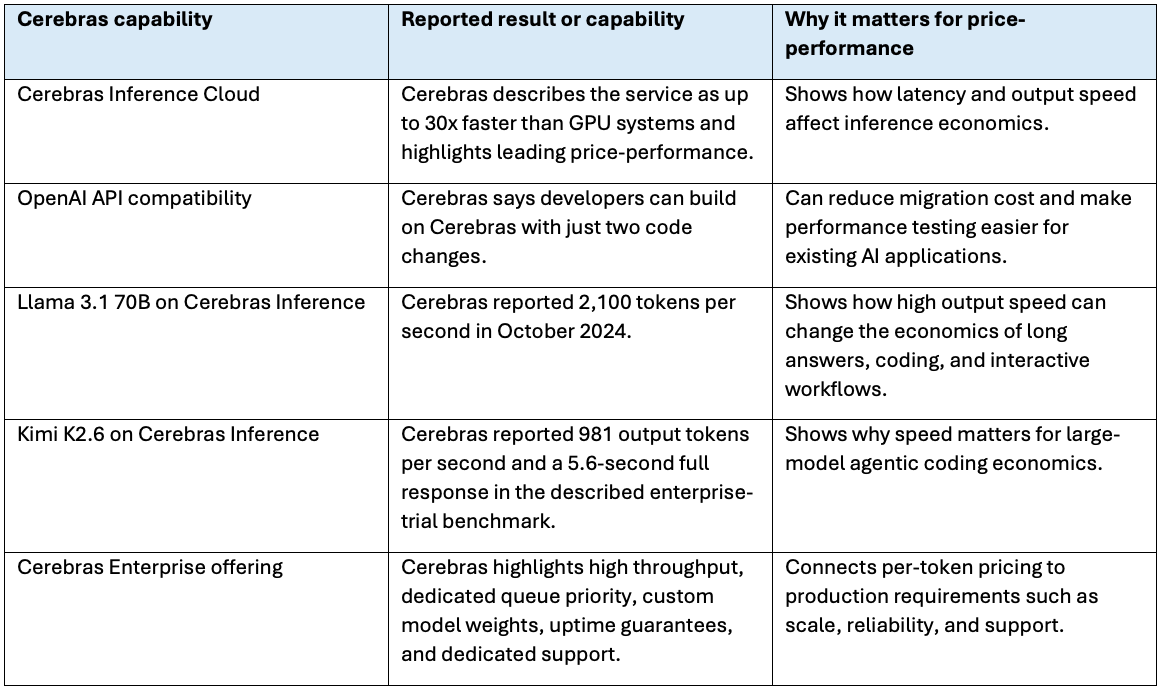
Cerebras Inference Cloud explicitly connects speed and economics. Cerebras describes the service as up to 30x faster than GPU systems and highlights leading price-performance for inference. The Cerebras pricing page also presents access tiers for developers and enterprises, including a free trial, self-serve developer usage, and enterprise support for production-scale workloads.
Cerebras is differentiated because the infrastructure story is tied to the chip story. The Wafer-Scale Engine is designed as a wafer-scale alternative to conventional GPU-based infrastructure. WSE-3 is described by Cerebras as a 46,225 mm² processor with 4 trillion transistors, 900,000 AI-optimized cores, and 125 petaflops of AI compute.
For buyers, the key question is whether Cerebras can deliver the required model quality with lower total response time and better cost per useful response for the workload. That evaluation should include output tokens per second, TTFT, throughput, reliability, API compatibility, model availability, support, and pricing.
Cerebras proof points for price-performance conversations
Cerebras speed results are relevant to price-performance because faster inference can change both user experience and infrastructure economics. Performance comparisons remain workload-specific and should be benchmarked with current data.

How businesses should compare AI inference costs
Start with the application and the required quality bar. Then measure the full cost of producing a useful output. A chatbot answer, coding-agent fix, research synthesis, and voice-agent turn all have different cost and latency profiles.
Teams should compare providers using the same model or similar-quality models. They should include prompt length, output length, context windows, retries, tool calls, concurrency, rate limits, and support requirements. They should also measure how speed changes productivity or engagement.
Finally, buyers should rerun cost comparisons regularly. Model catalogs, token prices, serving software, hardware utilization, and benchmark performance change quickly. The best inference provider today may not remain the best for every workload tomorrow.
How to calculate AI price-performance
- Define the business task and the required quality threshold.
- Measure input tokens, output tokens, retries, verification passes, and tool calls.
- Calculate cost per useful response, not only posted token price.
- Include time to first token, output tokens per second, and total response time.
- Benchmark throughput and p95 latency under production-like load.
- Factor in reliability, support, migration effort, API compatibility, and operational complexity.
Frequently asked questions
What is cost per token?
Cost per token is the price charged to process or generate tokens with an AI model. Providers often price input and output tokens separately.
What is AI price-performance?
AI price-performance measures how much useful work an AI system delivers for its cost. It includes token price, speed, quality, latency, throughput, reliability, and operational effort.
Why is cost per useful response better than cost per token?
Cost per useful response reflects the full cost of completing a task successfully, including prompts, outputs, retries, tool calls, verification, and model quality.
Can a cheaper token be more expensive in practice?
Yes. A cheaper model or endpoint can be more expensive if it is slower, less accurate, less reliable, or requires more retries and human review.
How does fast inference affect AI cost?
Fast inference can reduce waiting time, improve productivity, allow more useful reasoning within the same latency budget, and make agentic workflows more practical. Its value should be measured against the full task cost.
How does Cerebras approach price-performance?
Cerebras connects price-performance to fast inference by running leading models on wafer-scale infrastructure and offering developer and enterprise access to Cerebras Inference Cloud.
Should businesses choose the lowest-cost LLM provider?
Not automatically. They should choose the provider that delivers the required quality, latency, throughput, reliability, security, and cost per useful response.
Is price-performance different for AI agents?
Yes. Agents often make many model calls and tool calls. Their true cost includes the full chain of model usage, latency, retries, and task success, not a single token price.
Related glossary terms
Fast AI inference; Fastest AI / Fastest LLM; AI inference; LLM inference; Inference API; Tokens per second; Time to first token; Latency vs. throughput; Cost per token; Real-time AI; Agentic AI infrastructure; AI coding agents; Reasoning models; AI chip; AI accelerator; Wafer-Scale Engine; GPU vs. AI accelerator; NVIDIA alternative for AI inference.
Source links
- Cerebras Inference
- Cerebras Pricing
- Cerebras WSE-3 / Wafer-Scale Engine
- Cerebras Inference now 3x faster: Llama 3.1 70B breaks 2,100 tokens/s
- Cerebras Brings Trillion Parameter Inference to Enterprises with Kimi K2.6
Last updated: June 11, 2026