In recent months, increasingly sophisticated AI agents have infiltrated real production infrastructure. One gained code execution access on dozens of a third party’s servers. Another uploaded malicious software and accessed a live database. A third breached three companies using guessed or exposed credentials.
These incidents show how AI is transforming cybersecurity: swarms of AI agents are powering attacks at great speed and scale, and defenders must continually outpace them.
The urgency of cybersecurity is reshaping engineering priorities at the labs. On a recent a16z podcast, Greg Brockman said OpenAI redirected 25% of its production engineers to build a “defense factory,” an always-on ultra-fast system for finding, triaging, and fixing cyber vulnerabilities. His message is clear: if the attack is fast, then the defense must be faster.
AI is Transforming Cybersecurity Defense
CrowdStrike’s 2026 Global Threat Report found that operations by AI-enabled adversaries have increased 89% year over year, with sophisticated actors using LLM-enabled malware to automate reconnaissance and document collection. Average breakout time fell to 29 minutes; the fastest observed breakout took 27 seconds, and data exfiltration began within four minutes in one intrusion.
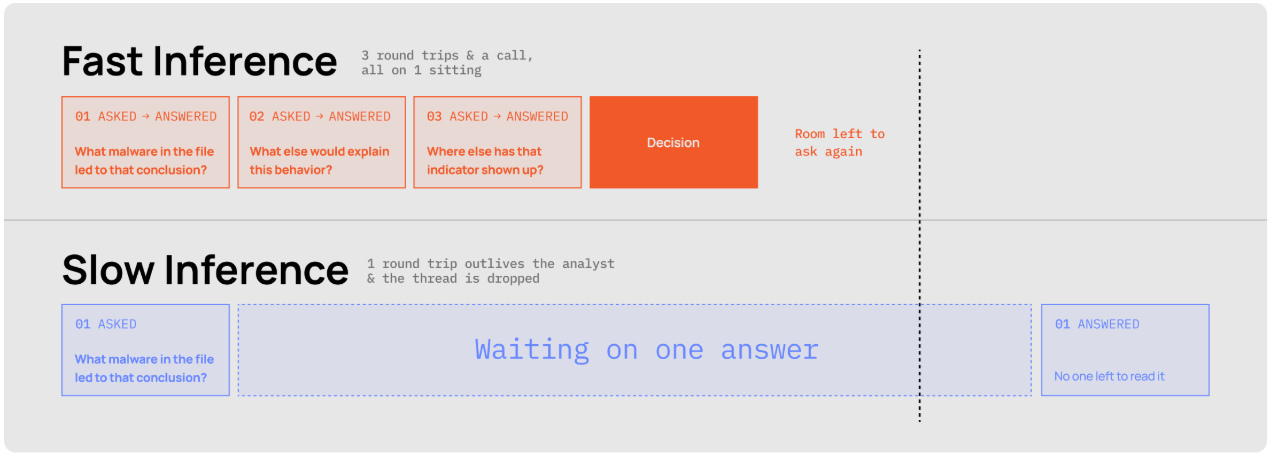
Defense teams are fighting a continuous, uphill battle. Attackers need only one successful path in, while security teams must separate real threats from noise, validate the evidence, and contain an intrusion without disrupting legitimate activity. Closing that gap depends on how quickly defensive AI can return actionable evidence for security teams. Each investigation unfolds through a sequence of follow-up questions: What in the file looks malicious? Does the process tree support that conclusion? Could this be routine activity on a build server? Each answer determines the next question, so delays compound across the investigation.
In the age of AI, faster inference speed is becoming an invaluable advantage for security teams. When answers arrive in seconds, analysts can inspect the telemetry, test competing explanations, and isolate the affected host or revoke compromised credentials before the attacker moves laterally or begins exfiltrating data.
Cerebras Speeds Up AI-Powered Defense
Cerebras delivers the world’s fastest AI inference, helping defenders investigate and respond sooner. For example, Cerebras runs GPT-5.6 Sol Ultrafast up to 14× faster than standard processing, without compromising intelligence, precision, context, or reasoning. In security workflows, that can mean 5–10× faster triage and response, allowing analysts to test the evidence and act before the threat advances.
Our security team benchmarked the same model for the same prompt on Cerebras versus Standard Processing. The video shows how fast inference enables security analysts using AI tools to perform an analysis on a suspicious file. This entails prompting a model like GPT-5.6 Sol to rapidly inspect the file’s contents without executing it to determine whether it is malicious.
Analyzing unfamiliar files is routine security work. First, an analyst must understand the file's behavior, decide whether it is malicious, and extract its indicators of compromise, including contacted domains, IP addresses, and files it leaves behind. The analyst then searches those indicators across the environment to determine the scope of the intrusion and identify any secondary payloads. Until that search comes back, an analyst cannot be confident that containment and eradication were complete, making turnaround time nearly as important as the verdict.
On Cerebras, the analysis finishes in 58 seconds, helping defenders rapidly analyze and contain threats. The same model on Standard Processing takes 4 minutes and 43 seconds.
Faster Inference Is Indispensable for Today’s Security Teams
Malware analysis is one of many AI-powered use cases for security professionals that can be accelerated by Cerebras. Cerebras-powered inference can bring the same speed advantage to alert triage, threat hunting, incident response, vulnerability remediation, and other critical cybersecurity disciplines.
Through Cerebras’ partnership with CrowdStrike’s Falcon AI Detection and Response platform, enterprises can automate securing their businesses at industry-leading inference speeds on the industry’s leading AI-native security platform.
As frontier AI becomes increasingly capable for cyber defense, the value of speed only increases. Seconds saved across thousands of alerts and systems mean faster containment, less analyst backlog, and fewer opportunities for attackers to spread.
If the attack loop is fast, the defense loop must be faster. By removing inference as a bottleneck, Cerebras helps defenders act before attackers can advance.
[Learn more about how Cerebras powers CrowdStrike: https://www.cerebras.ai/customer-spotlights/crowdstrike]
————————————————
Thank you to our designers, Chris Kim and Halley Chang, for their graphics support, and to our Marketing, Product, and Security teams for their valuable insights and input.