Introducing Tungsten and Aviary
Michael James, Co-founder and Chief Architect of Advanced Technologies, Cerebras Systems
Last month, one of our researchers ran a plasma physics simulation across 98% of a Cerebras wafer. A coding agent wrote every line of it.
Today we are releasing the tools that made that possible. Tungsten is a language and compiler that lets you program the Cerebras Wafer-Scale Engine at a high level without giving up performance. Aviary is a portfolio of high-performance applications and tutorials written with it.
Much of modern science runs on simulation: how a metal ages inside a reactor, how a tsunami crosses an ocean, how a plasma moves in an electric field. These simulations advance in tiny steps through time, and adding more chips to a supercomputer doesn’t make those steps go faster. A wafer can. On some problems it runs hundreds of times faster than the largest supercomputers, turning a year of computing into a couple of days.
That speed changes what AI can do with science. A simulation fast enough to run beside an AI model becomes its world model, so the AI can test thousands of designs against real physics. And AI agents can now write the simulations themselves. Tungsten puts all of this in the hands of scientists who aren’t hardware specialists.
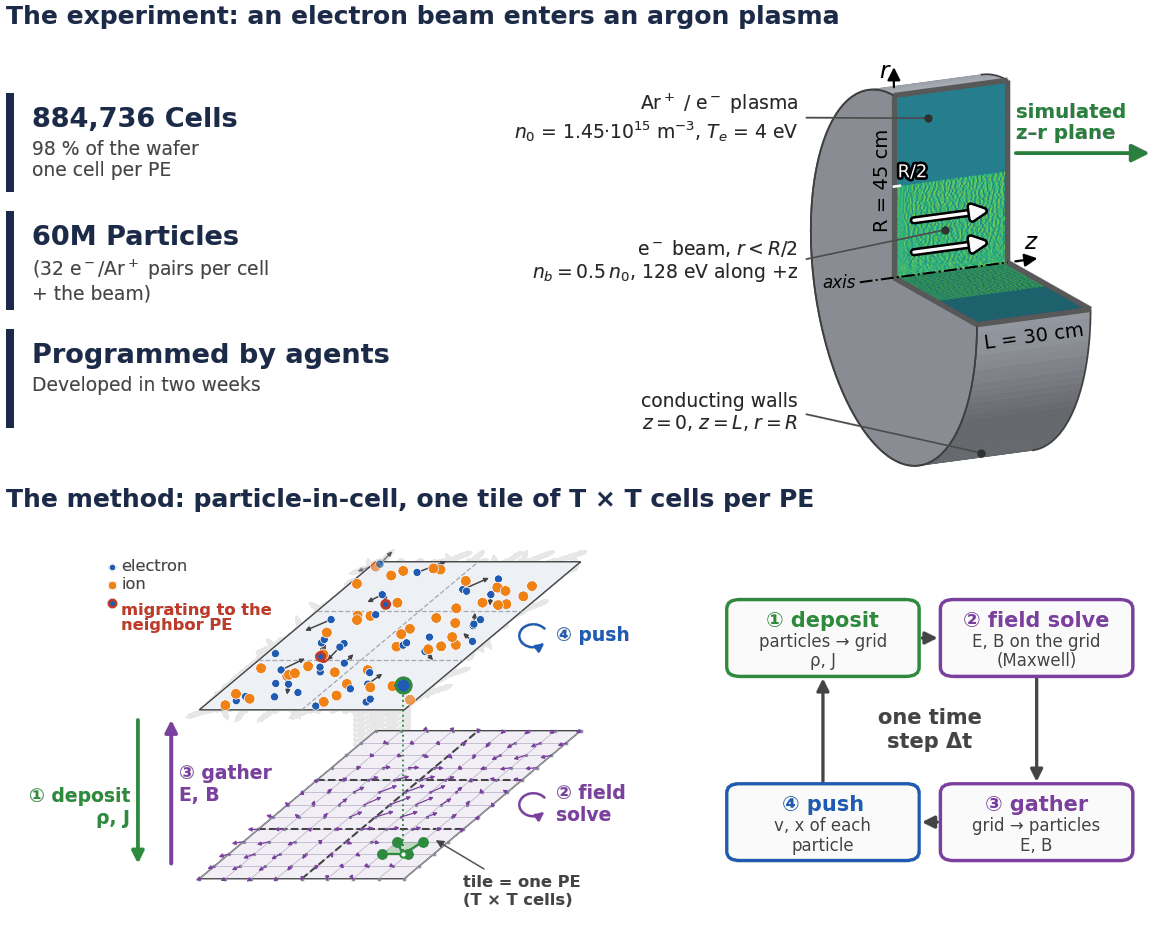
The agent-written particle-in-cell run: an electron beam entering an argon plasma, one cell per core.
What the hardware gives you
The Wafer-Scale Engine is a dataflow machine with 900,000 cores, so many that they work as a continuum: compute laid over local memory, joined by an on-wafer fabric. Data arriving at a core triggers the work that consumes it. Access pattern registers walk multidimensional arrays and fabric streams, so address arithmetic costs no instructions.
A single instruction can take a whole loop as its operand. Cores call functions on each other by sending messages across the fabric, and event-based control flow replaces polling and branching.
The hardware carries the loop and control overhead, so a core runs near peak even on short inner loops. Spread a problem thin across the wafer and it keeps getting faster, past the point where other machines stall or slow down. Traditional compilers, though, can’t reason about this machinery. Programming it has been the hard part.
The abstraction gap
Previous compilers exposed these features as intrinsics. Scalar code was fine. Anything that touched the vector, stream or event hardware had to call into it explicitly. In practice, every non-scalar program was written close to assembly.
You configured descriptors by hand. You wired tasks to events by hand. You routed the fabric by hand. We wrote a lot of code this way ourselves. It was fast. It also took deep expertise, and the result was hard to read, change or reuse.
A compiler that models the machine
Tungsten closes that gap. Its notation is mathematically natural and adapted to the features of the machine, so code reads close to the textbook form of the algorithm. The compiler carries a full model of the architecture and maps the code onto access pattern registers, event-driven tasks, fabric calls and loop-bearing instructions.
Here is the core of a Jacobi stencil update from the tutorial:
Each line is a loop over the whole block, and each compiles to a single vector instruction. <+- accumulates into the destination, like +=. There is no descriptor setup and no task wiring, just the stencil.
Compilers stopped asking programmers to allocate CPU registers decades ago. The compiler decides what lives in a register, and when it runs out, it spills to memory. Tungsten does the same for the wafer’s more complex resources: access patterns, loop definitions, fabric sockets and microthreads. Cost models and optimization passes assign them with the whole program in view, and swap them in and out as the program runs. Because the compiler owns these decisions, restructuring a code later is an edit, not a rewrite.
Aviary


Aviary includes several of the fastest codes in the world at what they compute:
- SNAP, a standard proxy for nuclear radiation transport codes, runs at 1.6 PFLOP/s on a single CS-4, ahead of 10,800 GPUs on the El Capitan supercomputer.
- HPCG, the benchmark used to rank supercomputers on real-world sparse workloads, reaches 1.04 PFLOP/s on a single system.
- Our wafer-scale molecular dynamics runs 748 times faster than Frontier, one of the world’s largest supercomputers [3].
A design optimizer is coming soon to Aviary. It couples an AI model to a physics simulation serving as its world model, with both running on the wafer. If you’re at SC26, come see it at our booth.
The applications range from compact stencil codes to full scientific applications. Smaller tutorial examples teach the language step by step.
Many of these applications grew out of our work with Sandia, Lawrence Livermore and Los Alamos national laboratories under NNSA’s Advanced Memory Technology program [5, 6]. The molecular dynamics applications build on our 2024 Gordon Bell Prize finalist work from that collaboration. They are not the same code, but that result already used an early version of Tungsten [2].
Built for agentic coding
The particle-in-cell code shows what agentic coding on Tungsten looks like. Particles move under the fields and migrate from core to core. An implicit solver computes the fields on a decomposed mesh from the particles’ positions and velocities.
One researcher. One coding agent. About two weeks in a chat window. The agent built the code from the published algorithms, validated its reference against the open-source XOOPIC code, and ran it on a problem modeled on the EMPIRE plasma code. Along the way it wrote the tests, figures and documentation, and found and fixed its own bugs. The full run advanced 60 million particles at 7,200 time steps per second, 430 billion particle updates per second on a single system. (For readers who aren’t plasma physicists, that is very fast.)
The Tungsten reference is complete enough to work this way, so you can try Tungsten with almost no startup cost. Learn it yourself too, though. Someone has to keep the agents on track.
Extending the reach
Our mission is to extend the reach of AI and science. When a high-performance code no longer takes a specialist to write, more problems become worth attempting.
The same Tungsten code runs on one wafer or across a cluster. Our global tsunami simulation ran on 64 wafers of an AI deployment [1], and those deployments scale to 2,048 systems [4].
We are proud to release Tungsten and Aviary, and we hope you find them as useful as we do. Everything is live at labs.cerebras.ai.
References
- T. Oppelstrup et al., “Beyond Exascale: Dataflow Domain Translation on a Cerebras Cluster,” SCA/HPCAsia 2026.
- K. Santos et al., “Breaking the Molecular Dynamics Timescale Barrier Using a Wafer-Scale System,” SC24, ACM Gordon Bell Prize finalist.
- “Breaking the mold: Overcoming the time constraints of molecular dynamics on general-purpose hardware,” Journal of Chemical Physics 162(7), 2025.
- Cerebras Systems, “Cerebras Systems Unveils World’s Fastest AI Chip with Whopping 4 Trillion Transistors,” press release, March 2024.
- Sandia National Laboratories, “Investigating stockpile stewardship applications for world’s largest computer chip,” news release, October 2022.
- Sandia National Laboratories, “The Advanced Memory Technology program kicks off round three with Cerebras,” August 2025.